 ·
3 minute read
·
3 minute read
 Starting a new life in another country often comes with
practical challenges. We spoke with Cynthia
Myrnes from Relocation about what it takes to settle in Norway and what people moving to Norway can do to make the process easier. Although based in Stavanger, her experiences and tips are relevant for newcomers across Norway.
Relocation was established in Stavanger in 1996 and supports companies relocating international employees across Norway, with offices in Stavanger, Oslo and Bergen. The company assists with immigration processes, housing and practical settling-in support for individuals and families moving to the region. Private persons
can also get support from Relocation.
From newcomer to advisor
Originally from Singapore, Myrnes, who was a physiotherapist, moved to Stavanger in 2008. What started as a personal move developed into a professional career to help others settle in Norway.
“At that time, there was very little information available for people moving here,” she says.
She quickly encountered challenges many newcomers still face today, from understanding administrative systems to building a social network. In response, she created a blog to share practical information about life in Norway and started organising social events.
This initiative grew into a wider community. Today, that early work continues through an active expat network in the region, including the Facebook group Stavanger Expats, which connects internationals and locals and now has more than 25,000 members.
The first year: language, work and a social network
Looking back, Myrnes describes her first year as demanding but formative. “The biggest challenges were finding a job, learning the language and building a network,” she explains.
She emphasises that Norwegian language skills are essential for long-term integration.
“Language opens many doors. It is an investment, but an important one.”
At the same time, she highlights that much of the Norwegian job market operates informally.
“A large share of positions are never advertised. You need to be proactive, talk to people and make connections.”
Her own approach was to become actively involved in the local community through volunteering, participating in social activities at her kids’ school, being class contact and part of parent committees ('FAU' in Norwegian).
“That’s where you meet people and start building a network,” she says.
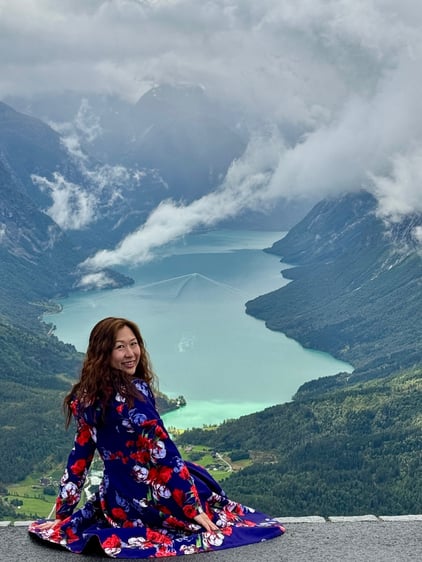
Cynthia in Loen, Norway. Photo: private
Understanding the system
Through her work, Myrnes now helps others navigate the same systems she once had to learn herself. This includes visa and immigration procedures, tax registration, healthcare access and schooling.
She also points to organisations such as Caritas Norway, which offers language cafés, and the Chamber of Commerce in the Stavanger region, which provides networking opportunities for professionals.
Building a life in Stavanger
Today, Myrnes considers Stavanger her home. She highlights the work-life balance as one of the biggest advantages compared to her previous life in Singapore.
“There is more flexibility and more time with the children. The system allows you to combine work and family in a different way than in many other countries.”
She also emphasises the freedom children experience in Norway, with more time for outdoor play and less academic pressure at an early age.
“It’s a much better life for families,” she adds.
Adapting to Norwegian life
Over time, Myrnes has adopted many Norwegian habits and traditions, including celebrations such as Christmas and Constitution Day in Norway.
“I feel that I fit in here,” she says.
At the same time, she maintains close ties to Singapore, returning to visit family and reconnect with her roots. Like many internationals, she describes her identity as shaped by both places.
She does add that the climate in Norway can be challenging, particularly during the darker months, and recommends finding ways to break up the winter.
Advice for newcomers
Her advice to others considering a move to Norway is both practical and realistic.
“Learn Norwegian, be proactive and talk to people,” she says.
She encourages newcomers to join organisations, attend events and build networks, both socially and professionally. A positive mindset is equally important.
“No country is perfect, including your home country. Focus on what works here and make the most of it.”
Among the resources she highlights are community groups, volunteer organisations and networking arenas that help newcomers connect and integrate more quickly. We have listed a number of them below.
Practical support for relocation
For those moving to southwest Norway, relocation services can provide structured support throughout the process, from immigration and housing to settling into everyday life. Companies like Relocation work closely with employers and international employees, helping to navigate Norwegian systems and making the transition into a new country more manageable.
Free information and networking sources for newcomers
- Relocation (in Stavanger, Oslo and Bergen)
- Relocation Agder (in Kristiansand)
- Stavanger Expats – Facebook group
- Expats in Kristiansand – Facebook Group
- Internationals, Newcomers & Friends in Arendal – Facebook Group
- Expats in Haugesund – Facebook group
- Stavanger Chamber of Commerce
- Caritas (They organise Norwegian and other courses and offer volunteer work)
- Professional women’s network
- Frivillighetssentralen (Norwegian Volunteer Centres)
- Sammen om en jobb
- Welcome Hub Agder
- Welcome Hub Haugalandet